COMMON PATTERNS
Chronic pain can affect more than one part of daily life.
Persistent or changing pain
Pain may be continuous or intermittent and can vary in intensity, location and character. A person's pattern may also change over time.
Sleep and fatigue
Pain can make it harder to fall asleep, stay asleep or feel rested. Poor sleep and fatigue may in turn make pain and daily demands harder to manage.
Movement and function
Pain may affect mobility, work, household tasks, exercise and participation in activities that matter to the person.
Mood, attention and social life
Persistent pain can affect concentration, confidence, mood, relationships and social participation. These effects vary and do not define the cause of the pain.
These are common experiences, not diagnostic criteria. Chronic pain varies substantially between conditions and individuals.
EAR-BASED STIMULATION
A research pathway in pain processing.
Pain is a real sensory and emotional experience, shaped by biological, psychological and social factors. It is more than the nervous system’s detection of potentially harmful stimuli.
The vagus nerve participates in brain–body communication. Researchers study whether stimulating its auricular branch at the outer ear (taVNS) can influence pain processing. Chronic pain has many causes, so one pathway or result cannot explain every person’s experience.
taVNS RESEARCH
What ear-based pain research found.
A systematic review reported a separate analysis of auricular stimulation studies across chronic pain conditions.
SYSTEMATIC REVIEW · AURICULAR SUBGROUP · 2024
A pooled signal in ear-based pain research.
Costa 2024 analysed eight ear-based studies separately and found a small-to-moderate pooled effect on pain intensity compared with control (effect size 0.42).
Pain conditions and stimulation protocols varied. This subgroup concerns ear-based stimulation, rather than the total result combining ear and neck stimulation. An average across studies does not establish benefit for every pain condition or individual.
Read Costa 2024These studies used their own taVNS devices and protocols and did not evaluate Neuvago.
NEUVAGO
Room for rest in a demanding day.
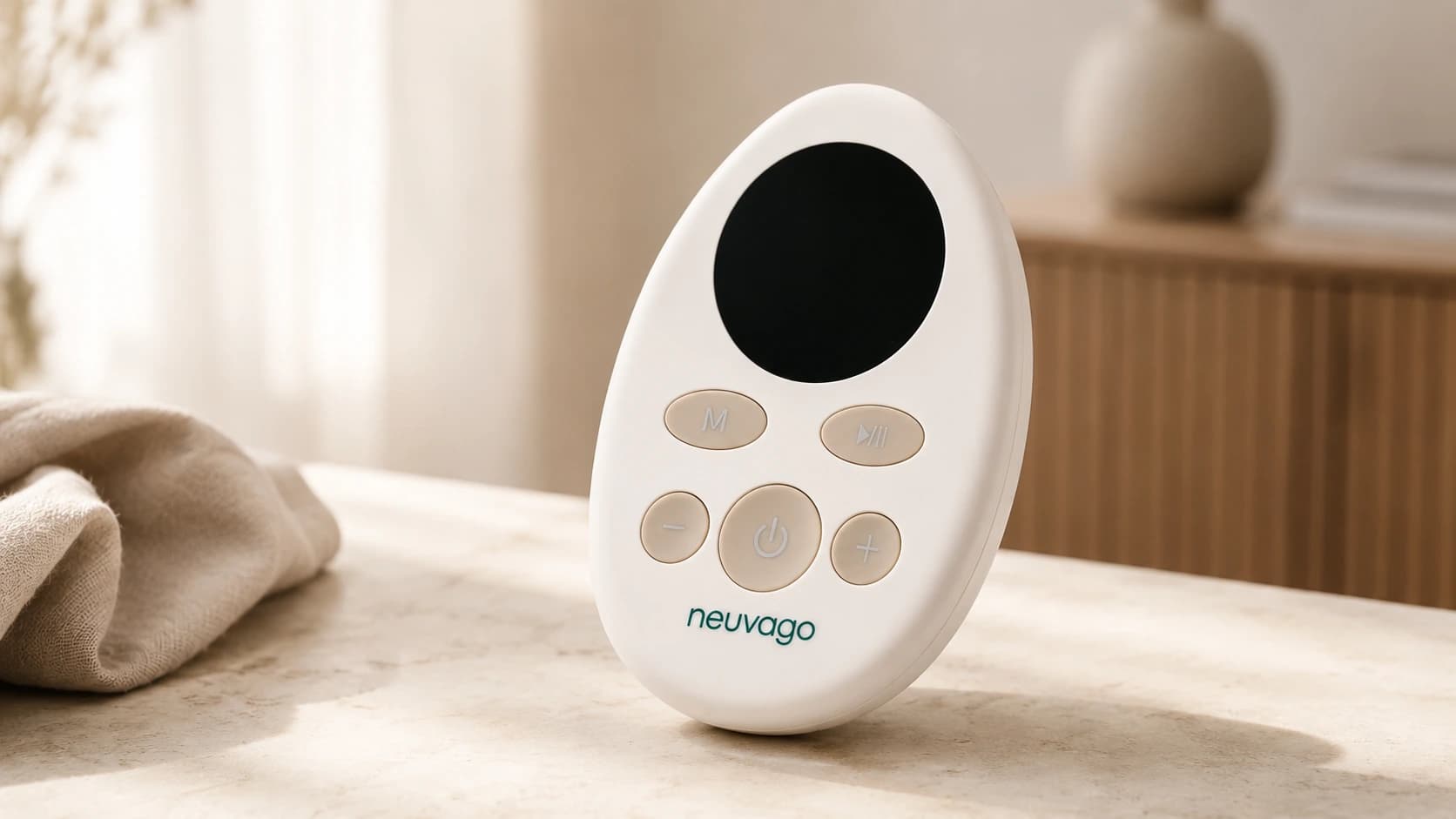
Neuvago delivers gentle ear-based stimulation designed to support relaxation and everyday wellbeing. A manageable pause can make room for calm and recovery; it is not a treatment for chronic pain.
Explore NeuvagoMEDICAL ASSESSMENT
When pain needs prompt or urgent medical assessment.
Discuss persistent pain and its impact with a qualified healthcare professional. Care depends on the cause and your needs and may include rehabilitation, movement, psychological support, medicines or a specialist pain service. Do not change prescribed treatment based on this page. A long-standing pain condition does not make every new symptom part of the same problem.
Contact local emergency services for sudden severe pain, chest pain or pressure, difficulty breathing, fainting, sudden confusion or new weakness.
Seek emergency assessment for new loss of bladder or bowel control, numbness around the genitals or anus, or rapidly developing weakness or numbness in the limbs.
Prompt assessment is important when pain begins after significant trauma or occurs with fever, chills, feeling seriously unwell, unexplained weight loss, cancer or immune suppression.
Talk with a healthcare professional about new, rapidly worsening or significantly changed pain, or pain that increasingly limits movement, function or daily life.
If pain contributes to thoughts of suicide or self-harm, or you are struggling to keep yourself safe, contact local emergency services or a crisis line now and tell someone you trust.
Urgent warning signs depend on where the pain is located and what other symptoms are present. This list is not exhaustive.
RELATED READING
Continue with relevant education and research.
Explore foundational nervous-system articles, pain-research context and related condition articles without treating those resources as a diagnosis or substitute for individualized care.
Learn
Research
Related conditions
SOURCES AND REVIEW
Evidence, context and review status.
This article uses authoritative pain definitions, chronic-pain classification, systematic reviews and current taVNS pain research. Findings remain limited to the pain conditions, devices, protocols and outcomes studied.
International Association for the Study of Pain — Terminology
External source ↗
International Association for the Study of Pain. IASP Terminology, including the revised definition of pain.
Used for the definition of pain, the distinction between pain and nociception, and the principle that biological, psychological and social factors influence pain.
International Association for the Study of Pain — Pain Management Center
External source ↗
International Association for the Study of Pain. Pain Management Center Toolkit, Chapter 1.
Used for the definition of chronic pain, primary and secondary chronic-pain classification, and multidisciplinary care context.
Costa et al., 2024
External source ↗
Costa V, Gianlorenço AC, Andrade MF, et al. Transcutaneous vagus nerve stimulation effects on chronic pain: systematic review and meta-analysis. PAIN Reports. 2024;9(5):e1171.
Used for the separate eight-study auricular subgroup (effect size 0.42), with variation in pain conditions and protocols.
Chen et al., 2025
External source ↗
Chen J, Kuang H, Chen A, et al. Transcutaneous Auricular Vagus Nerve Stimulation for Managing Pain: A Scoping Review. Pain Management Nursing. 2025;26(1):33–39.
Used for the 26-publication taVNS pain landscape, commonly studied conditions, protocol variation and research gaps.
Runge et al., 2024
External source ↗
Runge N, Caldeira C, Conran Z, et al. The bidirectional relationship between sleep problems and chronic musculoskeletal pain: a systematic review with meta-analysis. Pain. 2024;165(11):2455–2467.
Used for prospective sleep–pain associations and the uncertainty around the full bidirectional relationship.
Kim et al., 2022
External source ↗
Kim AY, Marduy A, de Melo PS, et al. Safety of transcutaneous auricular vagus nerve stimulation (taVNS): a systematic review and meta-analysis. Scientific Reports. 2022;12:22055.
Used for broad taVNS safety context and the limitation that adverse-event reporting was incomplete in many studies.
MedlinePlus — Recognizing medical emergencies
External source ↗
U.S. National Library of Medicine. Recognizing medical emergencies. Reviewed 8 January 2025.
Used only for general emergency symptoms in the urgent-assessment framework.
NHS — Cauda equina syndrome
External source ↗
Torbay and South Devon NHS Foundation Trust. Cauda Equina Syndrome patient information.
Used only for bladder, bowel and saddle-sensory warning signs in the urgent-assessment framework.
Evidence reviewed
27 August 2026
Editorial review
Neuvago Editorial Team
IMPORTANT INFORMATION
This article is provided for general educational purposes only and is not medical advice.
It is not intended to diagnose a condition or recommend treatment, and it does not replace assessment, diagnosis or care from a qualified healthcare professional.
Contact a doctor or another qualified healthcare professional if you have questions about symptoms, a diagnosis or treatment.
Seek urgent or emergency help for severe, sudden or rapidly worsening symptoms, or whenever you may be in immediate danger.