Flexibility matters
A regulated system is not always calm. It can rise for demand and return when the demand passes.
Research / Topics / Autonomic Regulation
Autonomic regulation research studies how the body mobilizes, settles, adapts, and returns. It is the physiology behind many of the topics Neuvago already explains in plain language: stress, sleep, recovery, HRV, vagal pathways, and nervous system regulation.
This topic connects vagus nerve stimulation, transcutaneous VNS, heart rate variability, and everyday regulation while keeping physiology separate from overconfident product claims.
Research bridge
Autonomic flexibility
Mobilize, settle, recover, return
HRV
Measurement window
Vagal pathways
One part of a wider system
Research interpretation
Useful context, not universal product proof
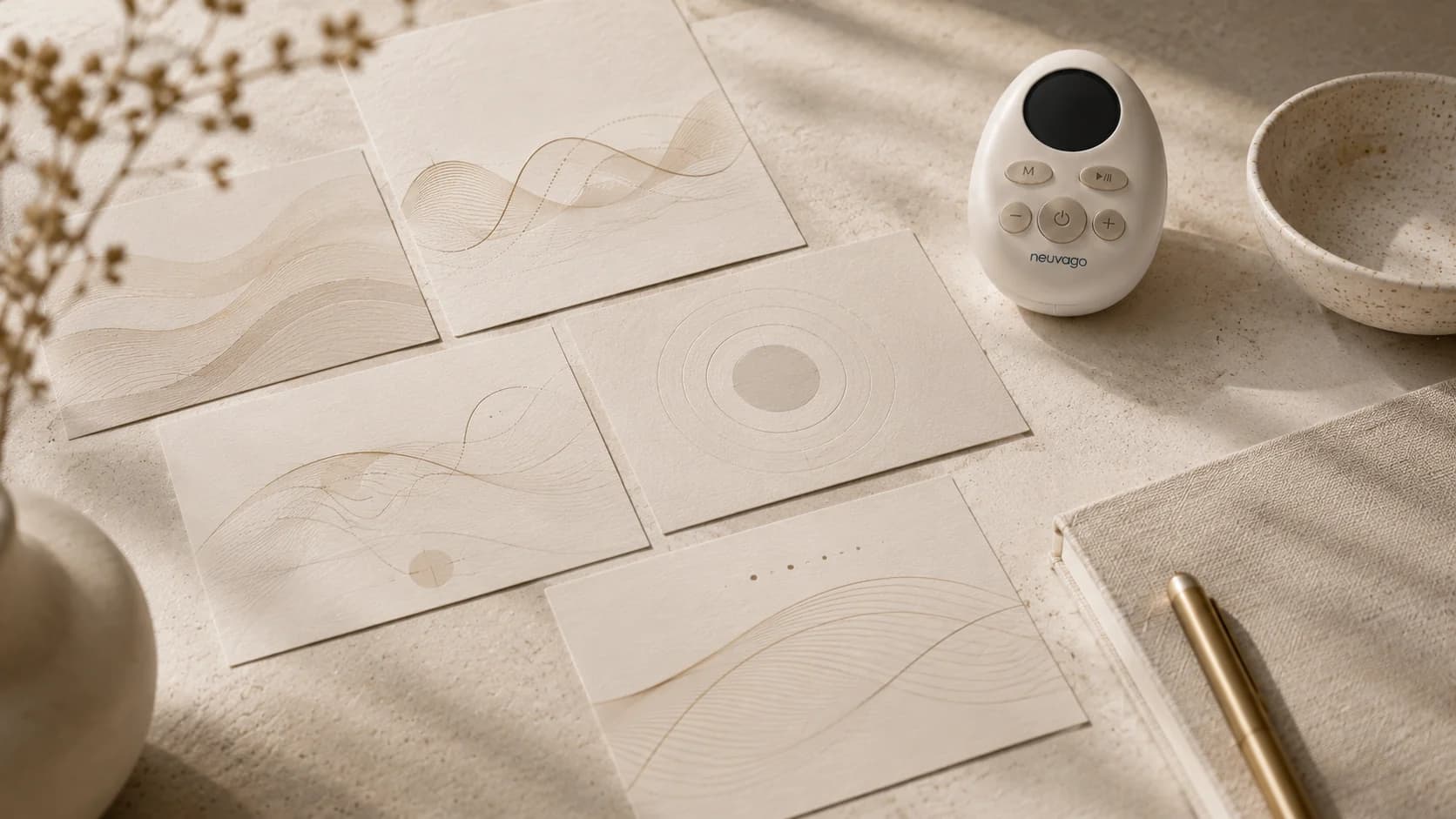
Autonomic regulation visual
The autonomic regulation layer connects sympathetic activation, parasympathetic return, HRV, stress, sleep, and recovery in a calmer, less overclaiming way.
In plain English
This topic is about how the body mobilizes, settles, recovers, and adapts. It connects VNS, HRV, stress, sleep, breathing, and vagal pathways into one physiology layer without reducing the whole system to one score or claim.
A regulated system is not always calm. It can rise for demand and return when the demand passes.
HRV can provide useful context, but it is not a complete readout of the entire nervous system.
Stimulation should be interpreted alongside breathing, recovery, stress load, sleep, and measurement context.
Research ledger
A premium research page should make the boundary visible. Evidence can inform the category without becoming an automatic product claim.
Autonomic markers can help researchers study activation, recovery, vagal influence, and flexible state-shifting.
No single marker or protocol can fully describe a person’s internal state or guarantee a product outcome.
Neuvago can use this framework to educate about regulation routines while staying away from diagnostic or treatment claims.
Quick answers
The autonomic nervous system helps the body mobilize, settle, recover, and return. Research often focuses on how flexible those state shifts are, not whether the body is always calm.
Vagal pathways are central to parasympathetic regulation, but autonomic regulation also involves sympathetic activation, baroreflexes, respiration, brainstem circuits, and context-dependent feedback loops.
Heart rate variability is widely used as a non-invasive marker of cardiac autonomic regulation, but it should be interpreted with measurement context, breathing, posture, time of day, and method limitations.
Vagus nerve stimulation, tVNS, and taVNS are easiest to understand when placed inside the broader physiology of autonomic regulation, target engagement, safety, and study design.
Autonomic context
The autonomic nervous system is often simplified into sympathetic “fight or flight” and parasympathetic “rest and digest.” That shorthand is useful, but the research picture is richer. The body is constantly adjusting cardiovascular, respiratory, digestive, immune, and attentional states through feedback loops.
For readers, the practical value is understanding why stress, sleep, recovery, HRV, and vagus nerve stimulation often appear in the same physiology discussion.
Mobilize
Sympathetic activity helps the body respond to challenge, effort, uncertainty, and demand. In research, it is often discussed alongside arousal, cardiovascular response, and stress physiology.
Settle
Parasympathetic pathways, including vagal influences on the heart, are involved in slowing, settling, restoration, and flexible recovery after demand.
Adapt
A flexible system can mobilize when needed and return when the challenge passes. This is why regulation research often focuses on adaptability rather than constant calm.
Interpret
Autonomic signals are shaped by breathing, posture, sleep, stress history, attention, environment, medication, and measurement method. Context is part of the signal.
Research themes
Autonomic regulation is not just a peripheral body process. It involves communication between the brain, brainstem, heart, lungs, gut, immune system, and sensory feedback from the body.
The vagus nerve plays an important role in cardiac regulation, especially in fast parasympathetic influences on heart rate and recovery after physiological demand.
HRV research gives a non-invasive window into cardiac autonomic regulation, but it does not measure the entire autonomic nervous system or prove one simple internal state by itself.
Stress research often examines how autonomic patterns shift during challenge and how quickly the system returns toward baseline after pressure ends.
VNS, tVNS, and taVNS studies often ask whether a stimulation protocol influences autonomic markers or related neural pathways in a measurable, repeatable way.
For a wellness brand, the practical question is how research context can support safer education around stress, sleep, recovery, and routines without becoming medical claim language.
Evidence signals
This overview is not a systematic review. It highlights selected research directions and foundational sources that help explain how autonomic regulation is interpreted.
Task Force, 1996
A foundational standards paper for HRV measurement and physiological interpretation. It remains an important reference for why HRV requires methodological care.
View PubMed recordThayer & Lane, 2000
A major theoretical model linking autonomic regulation, emotional regulation, attention, and cardiovascular control into a broader brain–body framework.
View PubMed recordCapilupi et al., 2020
A review of VNS and cardiovascular physiology, including vagal influence on cardiac control, HRV, homeostasis, and translational neuromodulation questions.
View PubMed recordKim et al., 2018
A meta-analysis and review examining why HRV is commonly used in psychological stress research and how stress-related autonomic patterns are interpreted.
View PubMed recordMeasurement principles
Different HRV metrics, recording lengths, devices, preprocessing choices, and breathing patterns can change interpretation. A single HRV number should not be treated as a full diagnosis of autonomic state.
A momentary reading during stress, sleep, illness, caffeine, exercise, or poor recovery is not the same thing as a stable baseline across repeated measurements.
Vagal regulation is often discussed through HRV, but the relationship between HRV metrics and vagal influence depends on physiology, protocol, and the specific question being asked.
Someone may feel calm while physiology remains activated, or feel alert while some markers look stable. Research interpretation should leave room for both subjective and objective signals.
HRV and interpretation
HRV is one of the most useful measurement bridges between the autonomic nervous system and everyday regulation conversations. But HRV is not a standalone truth machine. It reflects cardiac autonomic regulation under specific conditions, not the entire state of a person.
For Neuvago, HRV language needs the same caution. It can help explain stress load, recovery, and flexibility, but it should not be used as a simplified promise that a device has created one universal physiological outcome.
VNS interpretation
Vagus nerve stimulation research is often discussed through outcomes such as HRV, mood, stress, inflammation, pain, or sleep. Autonomic regulation helps keep those conversations organized by asking what pathway, protocol, marker, and context are actually being studied.
A stimulation protocol is not the whole regulatory picture. Autonomic state is shaped by sleep, stress load, breathing, context, health status, and repeated patterns over time.
Calling something vagus nerve stimulation does not by itself establish the mechanism. Research needs clear stimulation sites, parameters, controls, and outcome measures.
A study showing changes in HRV or other autonomic markers does not automatically prove broad benefits, clinical outcomes, or equivalence across devices.
For Neuvago, autonomic regulation is best used to explain routines, state-shifting, recovery support, and responsible education rather than disease treatment claims.
Responsible interpretation
Autonomic regulation connects lived experience with physiological research, but the interpretation should stay educational. For Neuvago, it does not imply diagnosis, treatment, prevention, cure, or guaranteed physiological change.
Its practical value is helping readers understand the science vocabulary before considering how the Neuvago device and app fit into guided wellness routines.
The Learn page explains nervous system regulation in plain language. This research topic gives that concept a stronger evidence-oriented backbone.
HRV is a useful measurement window with important limitations; it is not a complete proof of calm, health, or product effect.
Autonomic regulation helps connect VNS/tVNS research to stress, sleep, and recovery while keeping the interpretation physiological and conservative.
Readers who understand the physiology, limits, and vocabulary behind regulation are better prepared to evaluate how Neuvago works without needing exaggerated claims.
Continue through related topics
Return to the broader VNS topic covering implanted VNS, non-invasive VNS, auricular stimulation, mechanisms, and responsible interpretation.
Explore VNS researchMove into the method layer for tVNS, taVNS, stimulation sites, protocol variables, target engagement, and reporting standards.
Explore tVNS topicExplore HRV methodology, autonomic flexibility, vagal regulation, and why HRV appears so often in regulation research.
Explore HRV topicA plain-language Learn page for understanding activation, settling, recovery, return, and regulation in everyday life.
Read the guideMove from research context into the lived-experience pathway for stress, overload, activation, and recovery.
Explore stressUnderstand how evening activation, settling, and recovery connect the autonomic regulation topic to sleep-related user intent.
Explore sleepPractical next steps
Move from autonomic regulation research into the practical product experience: device placement, app guidance, session structure, and routines.
See how it worksUnderstand Neuvago as a non-invasive vagus nerve stimulator and app-guided wellness system with clear boundaries.
Explore NeuvagoReview the trust-focused research topic on adverse events, tolerability, contraindication awareness, and responsible interpretation.
View safety topicExternal references
Task Force of the ESC and NASPE, Circulation, 1996
Thayer & Lane, Journal of Affective Disorders, 2000
Thayer et al., Annals of Behavioral Medicine, 2009
Capilupi et al., Cold Spring Harbor Perspectives in Medicine, 2020
Hayano & Yuda, Journal of Physiological Anthropology, 2019
Kim et al., Psychiatry Investigation, 2018
Interpretation note
This material is educational and research-oriented. It is not medical advice and should not be used to diagnose, treat, prevent, or cure any condition. Autonomic regulation research can help explain the physiology behind stress, sleep, recovery, HRV, and VNS, but it should be interpreted with study design, device type, population, and intended use in mind.