Ear-based access
Auricular VNS focuses on parts of the outer ear associated with auricular vagal pathway discussions.
Learn / Auricular VNS
Auricular vagus nerve stimulation is the ear-based part of the non-invasive VNS conversation. It is often called taVNS, short for transcutaneous auricular vagus nerve stimulation, and it is one of the key terms people encounter when they research ear-based vagus nerve stimulation.
This guide explains what the term means, how it relates to tVNS and non-invasive VNS, what to look for in ear-based stimulation, and why Neuvago keeps the language practical, calm, and responsible.
Ear-based VNS
taVNS
Transcutaneous auricular vagus nerve stimulation
Ear-based
External placement
Guided
Comfort and routine first
Ear-based VNS visual
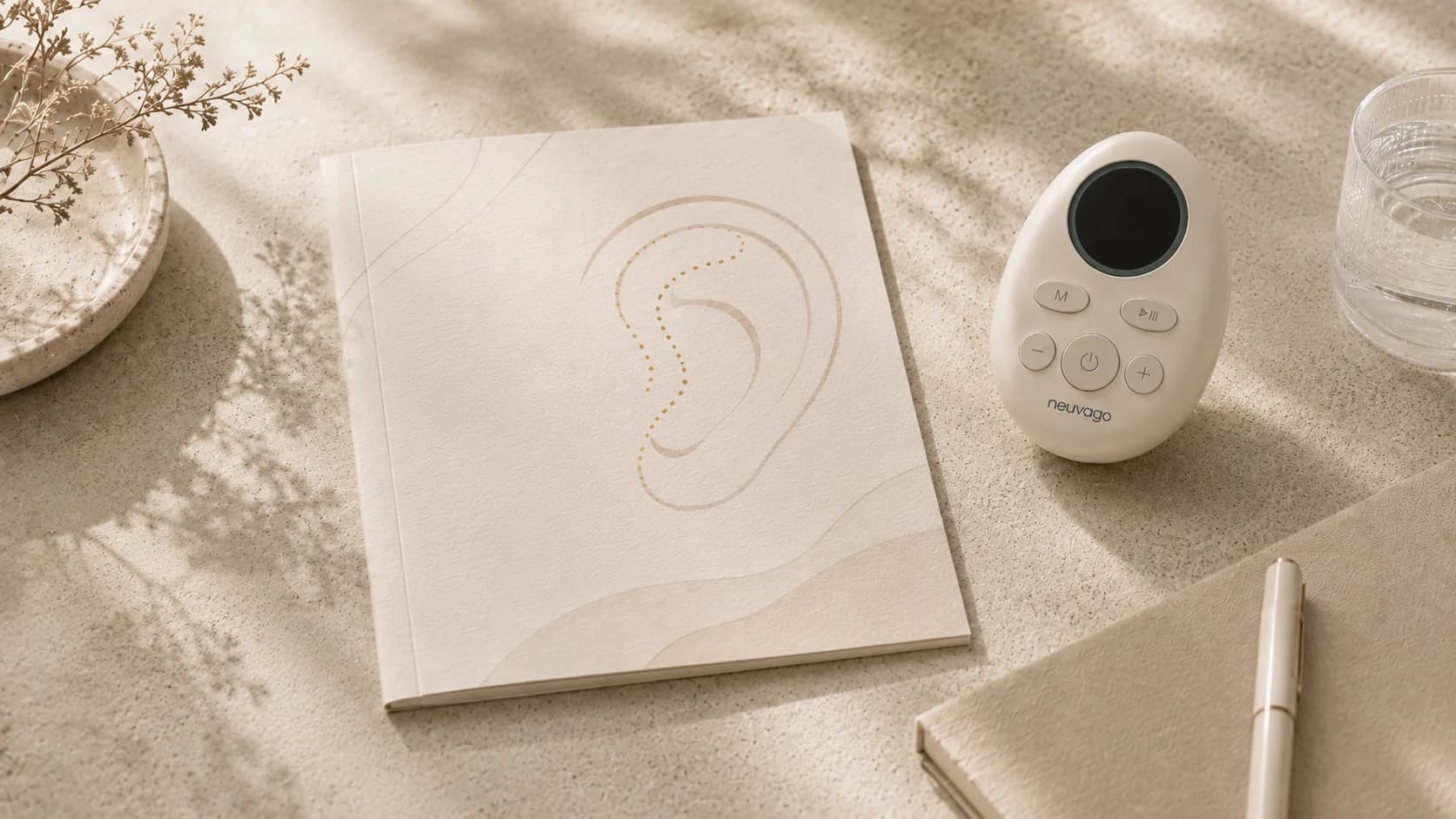
Ear-based VNS can be explained visually without electrodes, wires, or body placement: an abstract education layer, a clear device, and careful language.
In plain English
Ear-based VNS is often discussed as taVNS. It is a useful concept because it gives non-invasive VNS a concrete location, but it still needs careful explanation around placement, comfort, evidence, and claims.
Auricular VNS focuses on parts of the outer ear associated with auricular vagal pathway discussions.
Placement language should stay careful and avoid implying that every ear-based method has the same evidence.
For daily use, contact, sensation, stop-use guidance, and a clear routine matter as much as technical terminology.
Simple answer
The word auricular means related to the ear. In this context, auricular VNS usually refers to stimulation applied to specific outer-ear regions that are discussed in relation to auricular vagal pathways. In research, this is commonly described as taVNS.
That does not mean every ear device, placement, sensation, side-effect profile, or protocol is equivalent. A good explanation should make the method clear while keeping evidence, safety, intended use, and product claims in the right lane.
Auricular vagus nerve stimulation focuses on regions of the outer ear associated with auricular vagal pathways. It is commonly discussed as taVNS: transcutaneous auricular vagus nerve stimulation.
taVNS sits inside the wider category of non-invasive VNS and transcutaneous VNS. It is different from implanted clinical VNS and should not be treated as automatically interchangeable with other device types.
A useful ear-based VNS explanation should clarify where stimulation is applied, how sessions are guided, what the user may feel, and what the product is not claiming to diagnose or treat.
Terms to know
Everyday terminology is not always the same as research terminology. Ear VNS, auricular VNS, taVNS, and non-invasive vagus nerve stimulation can overlap in conversation, but the technical method still needs to be identified precisely.
Ear-based VNS
A plain-language term for stimulation approaches that use parts of the outer ear as the access point for vagus nerve-related pathways.
Transcutaneous auricular VNS
The technical abbreviation often used in research. It means stimulation through the skin at auricular, or ear-based, locations.
Auricular branch
A commonly referenced anatomical pathway in ear-based VNS discussions. Anatomical interpretation should remain careful and avoid overstating certainty.
Plain-language term
Ear VNS is a simpler label for the same broad ear-based conversation. Research papers more often use terms such as auricular VNS or transcutaneous auricular VNS (taVNS).
Why the ear matters
The ear gives the category a concrete external access point. That makes auricular VNS especially important for user education, because it connects a technical research term to something people can visualize: placement, comfort, session guidance, and routine.
Ear-based stimulation can be delivered externally, which makes it easier to understand as a non-invasive category than implanted clinical VNS.
VNS can sound abstract. Auricular VNS makes the discussion more practical by connecting the method to an external placement people can understand.
Terms like taVNS, stimulation site, intensity, pulse width, session duration, sham placement, and target engagement appear frequently in auricular VNS research.
Ear-based does not mean every sensation, placement, or device has the same evidence. The method should be explained with the same boundaries as the broader VNS category.
Anatomy and target interpretation
The outer ear has mixed sensory innervation. Good taVNS interpretation therefore separates anatomical plausibility, stimulation site, delivered protocol, sensation, and evidence of target engagement.
The auricle is supplied by more than one nerve. Anatomical maps support careful site selection, but they do not make every point on the ear a validated vagal target.
A site can be anatomically plausible without proving how strongly or selectively a specific stimulation protocol engaged vagal pathways in an individual participant.
Left or right ear, tragus, cymba concha, concha, canal, or another site are method details — not interchangeable labels.
Tingling or pressure can help describe comfort and tolerability, but sensation by itself does not establish vagal target engagement or a clinical effect.
What to evaluate
Ear-based VNS becomes clearer when you separate placement, stimulation settings, session guidance, study context, and the claims being made. Those details protect trust and make the product category easier to compare.
The external ear has mixed sensory innervation. A responsible study or device description should identify the stimulated region rather than treating the whole ear as one vagal target.
Clip, surface, or custom electrodes can differ in contact area, montage, polarity, pressure, and comfort. Those details affect both delivery and reproducibility.
Intensity, frequency, pulse width, waveform, duty cycle, session length, and total exposure can all change how a study or device experience should be interpreted.
Control sites and sham settings can differ in sensation and anatomical plausibility. Blinding quality matters when interpreting group differences.
Neuroimaging, HRV, pupil measures, symptoms, and clinical scales answer different questions. No single outcome is a universal readout of vagus engagement.
A finding from one taVNS protocol should not be transferred to every ear-based device. Product claims need evidence that matches the actual device, protocol, population, and intended use.
Research context
Auricular VNS research should remain separate from product promises. The useful approach is to explain the research area, connect it to the relevant topic pages, and keep the difference between evidence context and product-specific claims visible.
A foundational fMRI paper often cited in discussions of non-invasive stimulation of external-ear regions and central vagal projections.
Read Neuvago summaryA method-focused page explaining tVNS, taVNS, stimulation sites, protocol variables, reporting standards, and interpretation limits.
View tVNS topicA trust-focused page on adverse events, study populations, contraindication awareness, comfort, and responsible non-invasive VNS boundaries.
View safety topicResponsible interpretation
Auricular VNS is a specific method family, but specificity should not become overconfidence. Good education separates anatomy, protocol, research findings, and what a particular product can actually support with product-specific evidence.
Tingling, pressure, warmth, or comfort can be part of a user experience, but sensation alone does not prove a specific vagal mechanism.
A study using one ear location, parameter set, sham design, or population should not be generalized to every device or every wellness goal.
People with implanted electronic devices, heart rhythm concerns, seizure history, pregnancy-related questions, medical conditions, or active treatment plans should speak with a qualified clinician before use.
Neuvago context
Once the method is clear, the practical questions are how guidance works, how comfort is handled, and how the product fits within responsible wellness boundaries.
Neuvago can explain ear-based non-invasive VNS in a way that is practical and premium without sounding clinical or overclaiming.
For everyday use, placement, session structure, app guidance, comfort, and consistency should connect into one clear user experience.
Auricular VNS can support a clearer product explanation, but it should continue to be framed as wellness support rather than disease treatment.
Continue the pathway
Use a product-level framework to evaluate ear placement, contact, controls, evidence, safety, app terms, consumables, support, and live purchase conditions.
Open the buyer guideCompare auricular taVNS with cervical nVNS without treating the two access sites, protocols, or evidence bases as interchangeable.
Open the method comparisonStep back to the broader device-category guide covering nVNS, tVNS, taVNS, external stimulation, and wellness boundaries.
Read non-invasive VNS guideUnderstand the broader VNS category, including implanted systems, non-invasive approaches, and clear wellness boundaries.
Read VNS overviewStep back to the broader tVNS method layer, including stimulation through the skin, taVNS, nVNS, and why protocol details matter.
Read tVNS guideGo deeper into tVNS, taVNS, protocol variables, target engagement, and how method details shape research interpretation.
View tVNS researchMove from the plain-language guide into the focused research topic on taVNS anatomy, stimulation sites, parameters, controls, target engagement, safety, and evidence limits.
View auricular researchMove from education into the practical device-and-app explanation: placement, session guidance, comfort, and daily routine design.
See how it worksUnderstand Neuvago as a non-invasive vagus nerve stimulator and app system designed for calm, repeatable wellness support.
Explore NeuvagoSelected external references
These sources help frame auricular VNS as an evolving research area. They should be interpreted by method, population, control condition, and stimulation parameters.
Frangos et al., Brain Stimulation, 2015
Badran et al., Journal of Visualized Experiments, 2019
Farmer et al., Frontiers in Human Neuroscience, 2021
Kim et al., Scientific Reports, 2022
2024 scoping review
Practical next step
If you are comparing ear-based vagus nerve stimulation devices, the next useful step is to understand placement, session guidance, comfort, and how the product explains its intended use.